AI Requirements Tool for Banks
My first answer was “faster”, three times over: faster review, faster approval, faster build. Then I asked what happens when the document is wrong.
A faster document is not useful if it creates another round of checking. That shifted the design goal from generation speed to verification work, what the system can surface early, what it can explain, and what it should leave for the human.
My role: product designer on a take-home challenge, designing and building a desktop web app over three days (16–18 September 2026).
OJK PADK 1/2026 gave me 5 qualities to design for: to be complete, comprehensive, testable, consistent and clear.
The first design choice was not about generation. It was about whether the system had enough evidence to begin.
Upload, show a loader, generate. Missing information appears only after the document is already being written.
Read the files first. Show coverage and gaps. Generation unlocks after the gap has been seen.
The specification still has to be complete, comprehensive, testable, consistent and clear.
Separate paths for clean, mixed and raw input made tidy input easy and messy input harder. The messy case was the real problem.
A confidence score tells me how the system feels. It does not tell me what to do next. The more important the task, the more control the user needs. That means we shouldn’t offer easy ‘next step’ agreements when handling these sensitive parts.
Generate plausible prose everywhere and attach a confidence caveat underneath.
Separate “sourced”, “inferred”, and “assumed”. Leave the unsupported section visible instead of filling it with plausible prose.
I had used AI writing tools that gave me “80/100” or “low trust.” The number did not tell me what to do next.
A preprint benchmark of 10 AI models found the best model identified a median 47% of expert-identified problems and wrongly flagged 11%. It evaluated AI as a checker, not as a writer.
The first alternative made AI findings visible on open. It was fast, but it did not show what was wrong or whether each part had been validated and owned by the team. I kept the finding mechanism, but changed the review order in the next design decision.
This is where the design stops being only about information and starts being about attention.
Show the AI’s flags as soon as the reviewer opens the document. Reviewers then assume everything is fine and skip the review.
The AI checks immediately but keeps its findings hidden. Human review comes first; the diff follows.
A 34-person preprint study found AI support worsened defect detection in the studied setting, without significantly reducing time.
Review order is part of the product, not just the interface.
The human remains responsible for the requirement. The assistant’s job is to surface gaps, expose the basis of the draft, and make its own findings inspectable rather than invisible.
The responsibility boundary:
Three questions the design keeps asking.
Do we know enough to start?
Can I see the basis of this requirement?
Can the human still check independently?
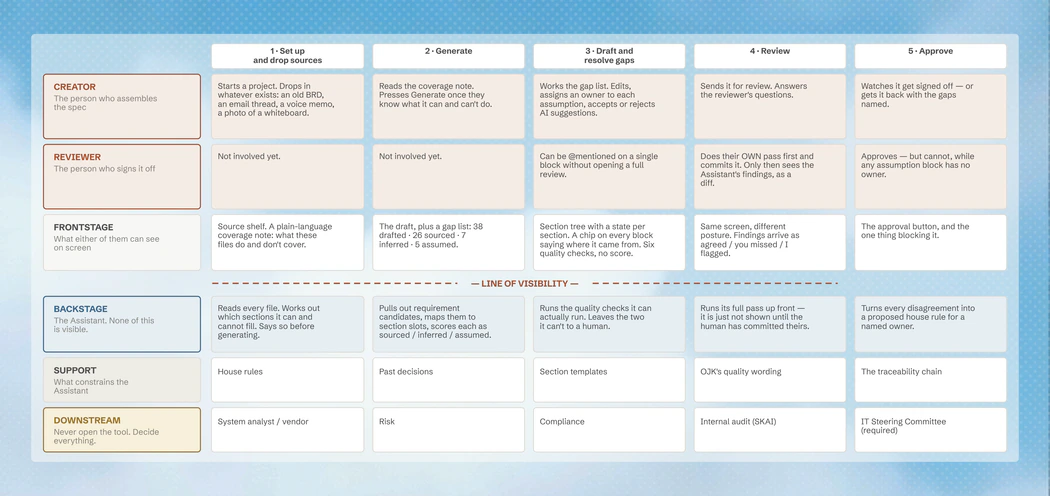
The core flow was the deliverable. The rest stayed outside the line with a reason attached.
[1] Actual time-saved measurement
[2] Defect-detection validation
[3] Production integration
[4] Trust-risk validation
[1] Input coverage and gap detection
[2] Sourced / Inferred / Assumed basis
[3] Reviewer-first review and post-review diff
[4] Core BRD/FSD generation flow
The design addressed the quality bar and gave reviewers new ways to inspect requirements. But without testing it with real reviewers, I couldn't claim it saved time, improved defect detection, or avoided over-trust.
[1] OJK quality bar
[2] Published / preprint research
[3] Prototype behavior
[1] Gap detection
[2] Sourced / Inferred / Assumed
[3] Reviewer-first review
[1] Actual time saved
[2] Defect detection improvement
[3] Over-trust risk
Submitted 18 September 2026. No feedback received, so there is no result to report.
Cap research earlier, test a speed-first mode against the quality-first flow, validate the trust risk before treating the design as successful.